Team Performance · 15 October 2026 · 5 min read
Crisis Leadership Training: Rehearsing the Bad Day
Plan crisis leadership training around realistic decisions, clear roles and useful debriefs, so your team can rehearse a bad day without creating one.
Written by Christopher Barber
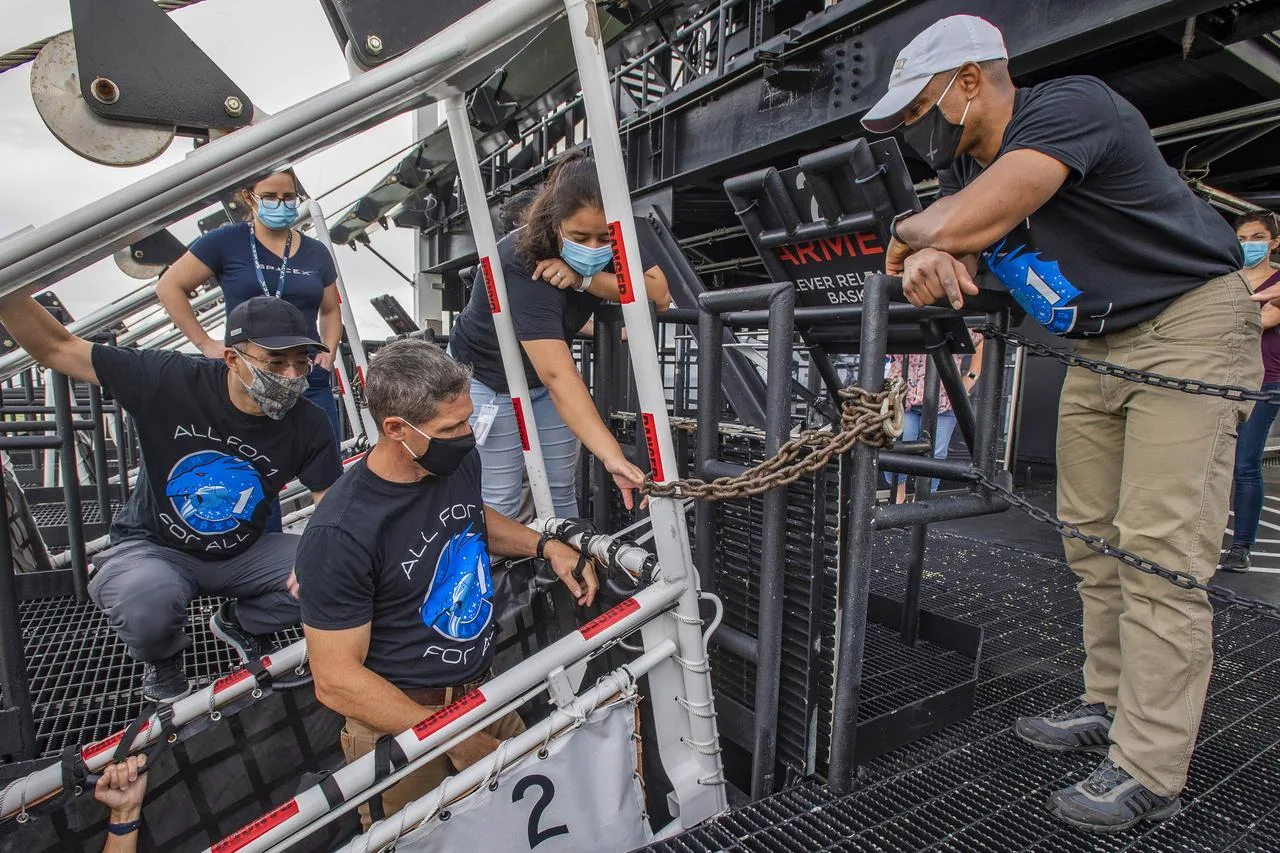
Photograph: CCP Crew-1 Astronaut Training: Emergency Land Egress Exercises — NASA, public domain
A crisis plan can explain who should be called without showing whether those people can work together. Crisis leadership training should test that gap. The aim is not to frighten participants or reward whoever looks most composed. It is to rehearse coordination when normal arrangements are under strain.
Begin with the decisions your team might realistically face. A service interruption, loss of access to a building or critical supplier problem can create useful practice without an elaborate disaster narrative. The best scenario for your purpose is one that exposes a meaningful dependency, not the one with the most dramatic opening slide.
Define the capability before writing the story
Choose a limited number of behaviours to observe. You might want leaders to establish an incident lead, distinguish confirmed information from speculation, or agree who can authorise a pause. These are things an observer can record. A broad ambition to improve confidence is harder to assess and easier to satisfy superficially.
Separate leadership practice from technical certification. A tabletop discussion can reveal unclear decision rights, but it does not demonstrate that equipment, emergency systems or specialist procedures work. Where those need testing, involve the competent people and follow the appropriate operational standards. Be explicit about what the exercise cannot establish.
Agree the boundary between the exercise and live work. Participants should know how to report a real incident, what communication channels are simulated and who can stop proceedings. Training should never make an employee uncertain whether an instruction creates a genuine obligation outside the room.
Design pressure with a purpose
Introduce information in stages, with each update connected to a learning objective. A conflicting report might test verification. An unavailable decision maker might test delegation. Adding interruptions simply to make people uncomfortable provides less useful evidence about the capabilities you want to develop.
Use credible constraints. Perhaps the team has incomplete information, limited staff availability or a deadline for a stakeholder update. Avoid making every option impossible. Participants need room to exercise judgement; otherwise the session becomes a demonstration that the facilitator controls the outcome.
Prepare facilitators to respond to unexpected but reasonable choices. If participants find a sound route that differs from the script, explore it rather than forcing them back towards a predetermined failure. The scenario serves the learning, not the other way round.
Make roles usable under strain
Ask the team to establish who coordinates, who advises, who decides and who records actions. In a small organisation, one person may hold several responsibilities. The important point is that those responsibilities are visible and their conflicts can be discussed before messages begin to multiply.
Include handovers and absence in the design. A plan that depends on one well-informed individual is worth examining. Ask an alternate to take over using the available record. Watch what they need to ask, what remains unclear and whether responsibility transfers explicitly rather than through assumption.
Bring communication into the exercise as actual work. Require participants to draft a short internal update or explain an instruction to another group. Discuss whether it distinguishes known facts from uncertainty, identifies required action and gives a next update time. Do not assess communication only through a discussion about its importance.
Observe decisions rather than personalities
Give observers a narrow brief and a simple way to note events. Record what happened, when it happened and its effect on the work. Describing someone as a poor communicator is less useful than noting that an instruction named no owner and therefore remained unassigned.
- Was the immediate priority stated and revisited?
- Did relevant information reach the decision owner?
- Were critical instructions acknowledged and understood?
- Did the team recognise when its authority or expertise was insufficient?
Be careful with apparent confidence. Someone speaking fluently may be working from an untested assumption. Someone asking basic questions may be uncovering a serious ambiguity. Review the quality of the team's information and reasoning, not the polish of an individual's performance under observation.
Debrief while the evidence is available
Allow proper time after the scenario. Ask participants to reconstruct key moments before evaluating them. What did they believe was happening? What options did they see? Which instruction did they think they had received? Different accounts can reveal a coordination problem that no single participant noticed.
Keep the conversation specific and fair. Examine system conditions alongside individual choices, including unclear policies, missing information and competing priorities. This does not remove accountability. It creates a more useful basis for deciding whether the answer is practice, clearer authority, a different process or a combination.
Offer another attempt at a difficult moment where practical. Replaying a short handover or decision discussion lets participants test an improvement immediately. A written intention to communicate better is not the same as trying a clearer instruction and seeing whether another person can act on it.
Repair what the rehearsal exposes
Finish with a small set of changes, each with an owner and a review date. Some may belong in the crisis plan; others may concern access permissions, contact arrangements or routine management habits. Distinguish an improvement identified from an improvement implemented. They are not interchangeable measures of readiness.
For your next rehearsal, choose one dependency that would be awkward to lose and one decision that would become urgent. Build the exercise around those two elements. After the debrief, check that the revised arrangement works when the usual expert is unavailable. That is a more useful test than whether everyone enjoyed the scenario.
Bring this to your team
We run NASA-style simulations, astronaut keynotes and leadership expeditions for organisations that need their leaders to make good calls under pressure.
Book a Call