Offsites & Simulations · 9 October 2026 · 5 min read
What a NASA-Style Simulation Teaches a Leadership Team
Understand what a NASA-style simulation for teams can reveal about communication, authority and decisions, and how to transfer the learning to work.
Written by Christopher Barber
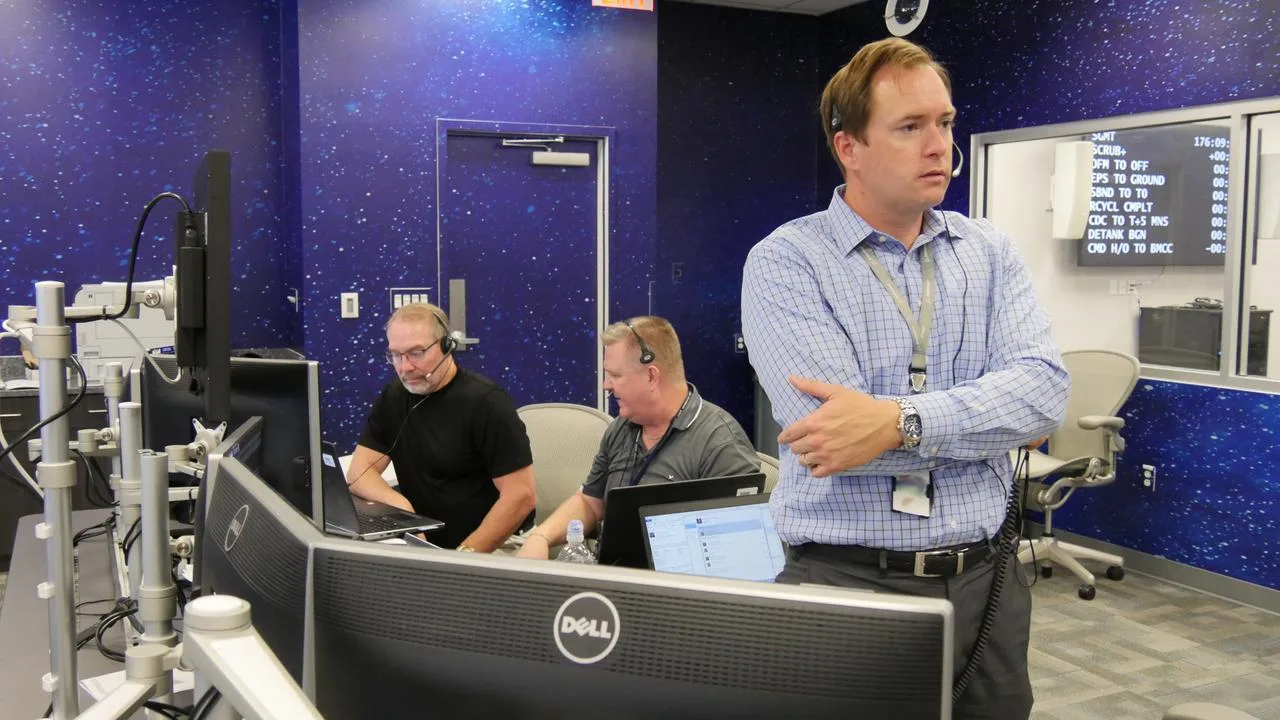
Photograph: Boeing CST-100 Starliner Simulation at Kennedy Space Center — NASA, public domain
Your leadership team can describe good collaboration fluently, yet important information still arrives late and decisions remain strangely ownerless. Another discussion about teamwork may not reveal why. A mission scenario gives the group a shared problem in which communication and judgement have visible consequences.
Separate a mission setting from official endorsement
NASA-style describes a design approach or setting; it does not by itself establish affiliation, accreditation or approval. Ask suppliers precisely what the description means. A space-themed room is not the same thing as a well-designed exercise in interdependent work, and technical decoration cannot compensate for weak facilitation.
The useful features are operational: distributed information, defined responsibilities, a changing situation and a common objective. Participants should need one another's judgement. If success rests on remembering space facts, the design has confused subject knowledge with leadership practice. A good briefing makes the task accessible without removing uncertainty.
Immersive Leaders by ISSET uses NASA-style mission simulations as a setting for leadership development. The relevant buying question remains what participants will do, what facilitators will observe and how the experience connects to the team's actual responsibilities.
Watch what happens when information is uneven
In a mission scenario, different roles can receive different pieces of the situation. This makes an everyday organisational problem unusually visible: people often assume that others know what they know. A technically accurate update may still be useless if the recipient cannot understand its implication for the wider objective.
Observe whether participants communicate meaning as well as facts. Do they explain what has changed, why it matters and what response is needed? Do recipients confirm understanding, or does silence get mistaken for agreement? The point is not to make every exchange longer. It is to make important exchanges complete enough to support action.
- Distinguish information that requires action from information offered for awareness.
- State uncertainty openly rather than polishing it into apparent certainty.
- Confirm who will act when a message changes the plan.
These habits transfer readily to project handovers and executive decisions. They are especially useful where the person receiving an update cannot inspect the underlying work directly.
Examine authority before celebrating decisiveness
A mission clock can tempt the loudest participant to take command of everything. That may look efficient until specialists stop contributing or decisions accumulate around a single overloaded person. Watch whether the team distinguishes accountability for the mission from expertise about a particular problem.
Clear authority should make challenge easier, not unnecessary. Participants need to know who decides, who advises and what triggers escalation. When conditions change, the group should be able to revise its coordination without silently rewriting every role. Confusion here often resembles an ordinary organisation more closely than anyone expected.
During the review, ask whether people understood their authority or merely inferred it from seniority. Someone who waited may have been respecting an assumed boundary. Someone who intervened may have thought no boundary existed. Those are different design problems, and neither is solved by telling everyone to be more proactive.
Use the clock to inspect decision quality
Time pressure makes the trade-off between speed and certainty tangible. The lesson is not that fast decisions are brave or slow decisions are careful. It is that teams need a proportionate method for deciding what must be known before action and what can remain uncertain.
Look for explicit assumptions, review points and reversible choices. A team can act before every question is answered while still making its reasoning visible. Conversely, an apparently decisive instruction may conceal an untested dependency that nobody feels able to raise.
The facilitator should distinguish an unhelpful delay from a necessary pause. Ask what the team gained by waiting and what it risked by proceeding. Judge the process using information available at the time, rather than treating the eventual outcome as proof that every earlier choice was sound or foolish.
Make the debrief more rigorous than the spectacle
A memorable setting can crowd out the analysis unless time is protected for reflection. Reconstruct a specific turning point using participants' accounts and observation notes. Establish what each role knew before discussing what anybody should have done. Otherwise hindsight produces suspiciously easy lessons.
Avoid translating every detail into a corporate metaphor. A simulated technical failure need not represent a particular department. Transfer comes from recognising a pattern of coordination, such as unclear escalation or unconfirmed updates, and testing whether that pattern also exists at work.
- Which signal changed your understanding of the mission?
- What made it easy or difficult to challenge the current plan?
- Where did responsibility become unclear between roles?
Let effective practice receive equal attention. The team needs to know which behaviours to preserve, especially those that appeared unremarkable because they prevented trouble rather than creating drama.
Bring back a protocol, not a slogan
Choose a working agreement that addresses an observed weakness. This might define how urgent updates are labelled, when a decision must be reviewed or how a specialist can stop a discussion to flag an unresolved risk. Keep the agreement short enough to use under pressure.
Test it in a real meeting or handover and review the result. Ask whether the protocol clarified action or simply added language. The mission setting has done its job when the team can explain the mechanism behind a better decision and use that mechanism without needing a control room around it.
Bring this to your team
We run NASA-style simulations, astronaut keynotes and leadership expeditions for organisations that need their leaders to make good calls under pressure.
Book a Call