Offsites & Simulations · 28 October 2026 · 5 min read
Team Simulation Exercises for Corporate Teams: A Practical Guide
Choose team simulation exercises for corporate teams with clear objectives, credible scenarios and debriefs that connect decisions to everyday work.
Written by Christopher Barber

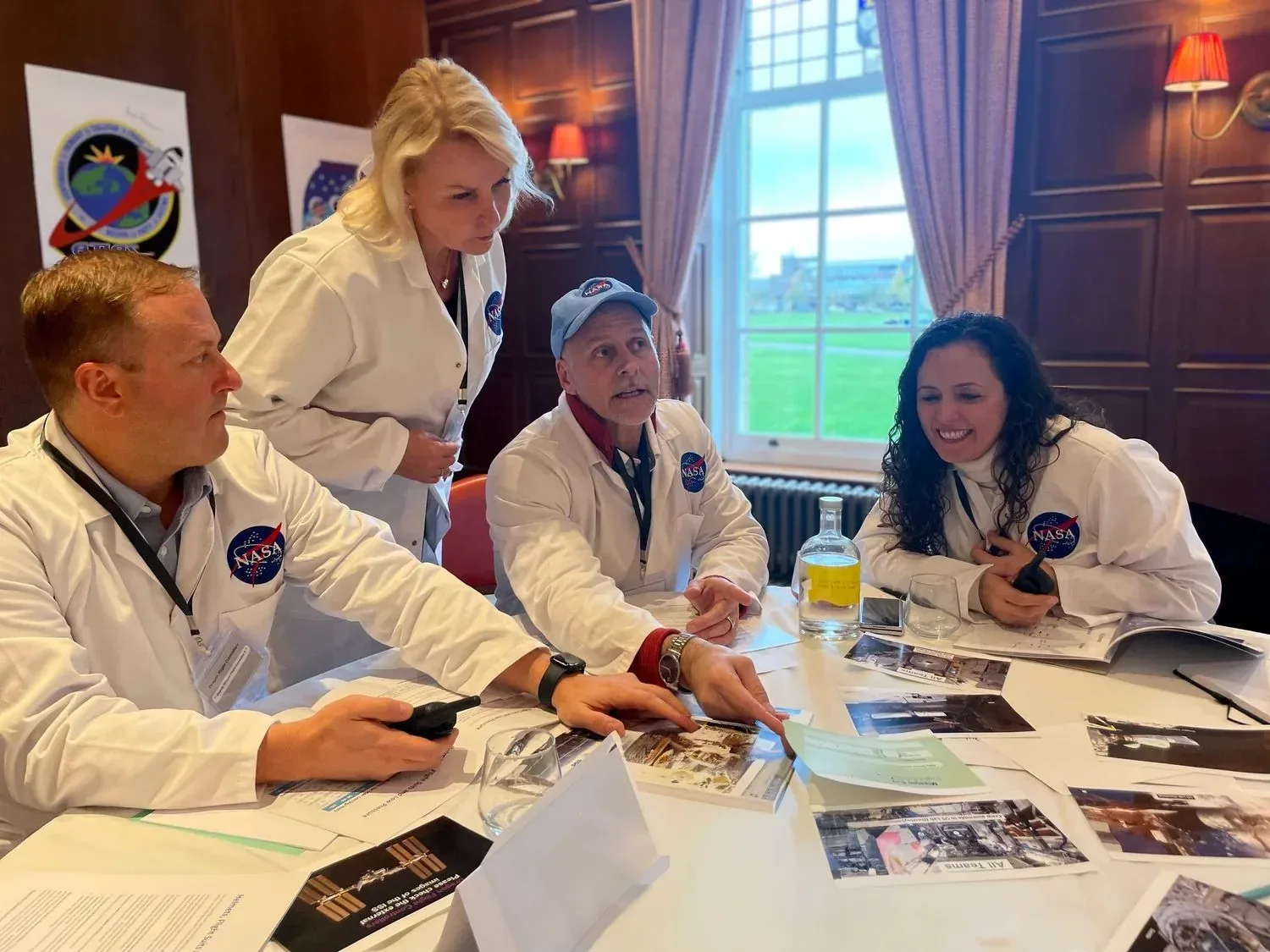
Photograph: Immersive Leaders programme photography — all rights reserved by Immersive Leaders by ISSET
You have been asked to find an exercise that will improve teamwork, and the options range from elaborate games to thinly disguised presentations. The difficulty is not finding something people will enjoy. It is choosing a task that reveals a working problem you can actually address afterwards.
Start with a behaviour you can observe
Replace broad ambitions such as better communication with a visible action. Perhaps the team needs to confirm critical instructions, surface conflicting information or ask for help before a deadline becomes impossible. An exercise earns its place when it creates opportunities to observe that action without requiring specialist knowledge.
Ask the sponsor for a recent example of the problem. What happened, what information was available and where did coordination break down? Use that account to shape the learning objective, not to recreate an embarrassing incident with recognisable characters. Participants should be examining a shared challenge, not guessing who commissioned a disguised complaint.
Agree what the exercise will not establish. A short simulation cannot diagnose someone's leadership potential or explain every difficulty in a working relationship. Its value is a sample of behaviour under particular conditions, followed by careful enquiry.
Match the mechanics to the coordination problem
Different exercise formats reveal different things. A distributed information task can show whether people share context rather than isolated facts. A resource allocation problem makes competing priorities visible. A changing scenario tests whether the team notices when its original plan no longer fits.
Do not choose complexity for its own sake. If participants spend the session decoding unfamiliar terminology, the exercise may reveal reading speed rather than collaboration. The task should be understandable while leaving the coordination genuinely demanding. Give everyone a useful role and a reason to interact beyond their immediate neighbour.
- Use separate information sets when the objective is cross-functional communication.
- Use competing demands when the objective is explicit prioritisation.
- Use changing conditions when the objective is reviewing assumptions.
Check that success depends on the intended behaviour. An exercise about collaboration is poorly designed if one confident individual can solve it alone while everyone else watches.
Decide how much pressure serves the learning
A deadline can reveal rushed assumptions, but pressure is not automatically educational. Participants need enough capacity to notice choices and reflect afterwards. Ask the supplier how difficulty changes, how confusion is distinguished from productive challenge and when a facilitator will intervene.
Avoid surprise humiliation. Public rankings, opaque scoring and unexplained penalties can make people protect their reputation rather than experiment. Explain the rules, boundaries and purpose before starting. If the exercise includes incomplete information, say that uncertainty is part of the task without disclosing every development.
Give people a clear way to raise access needs or discomfort privately. Participation should not depend on disclosing a medical condition to the whole team. Alternatives should retain meaningful responsibility, rather than assigning someone to the edge of the room with a clipboard and calling that inclusion.
Observe events rather than collecting impressions
Decide who is observing and what they will record. A useful note identifies a situation, an action and its consequence. For example, an updated instruction arrived but the team continued using the earlier version. That creates a concrete question about checking changes. Saying the group lacked agility does not.
Observers should also record effective behaviour. Otherwise the debrief becomes a hunt for mistakes and participants learn to defend themselves. Notice the clarification that prevented rework, the invitation that brought in missing expertise and the pause that allowed a plan to be revised.
Keep observation manageable. Trying to monitor every interaction produces a large collection of thin judgements. Focus on the agreed objective, and distinguish what was directly seen from what someone inferred. If recording is proposed, settle consent, access and deletion arrangements before the session.
Debrief the decision that changed the outcome
Begin with a factual reconstruction. Ask participants what they were trying to achieve and what they understood at the time. Different accounts are valuable evidence about information flow, not an inconvenience to tidy away. Resist explaining the lesson before the team has examined its own reasoning.
Choose a consequential moment rather than reviewing every minute. Explore which assumptions were checked, which signals mattered and what made an alternative difficult. Then ask where the same pattern appears in ordinary work. Similarity should come from participants' experience, not a facilitator insisting that everything represents the office.
- What information did you need but not request?
- Which decision had an owner, and which merely had an audience?
- What would you repeat when the next deadline becomes uncomfortable?
Allow disagreement about the interpretation. A tidy consensus is less useful than a specific hypothesis the team is prepared to test.
Transfer the lesson into an existing workflow
End by selecting a practical change small enough to use immediately. That could be a confirmation step in a handover or a visible trigger for escalating uncertainty. Name the working situation, the person responsible for trying it and the evidence that would suggest it helped.
Arrange a review through a meeting the team already uses. Ask whether the change occurred and what prevented it when it did not. If incentives or authority made the behaviour unrealistic, alter the system rather than demanding more enthusiasm. A successful simulation leaves the team with a better way to organise work, not merely a shared memory of being busy.
Bring this to your team
We run NASA-style simulations, astronaut keynotes and leadership expeditions for organisations that need their leaders to make good calls under pressure.
Book a Call